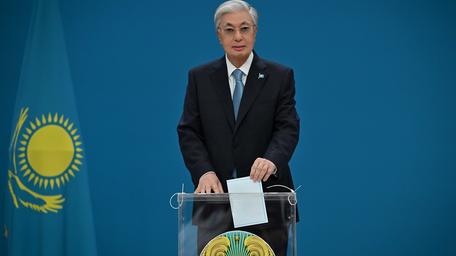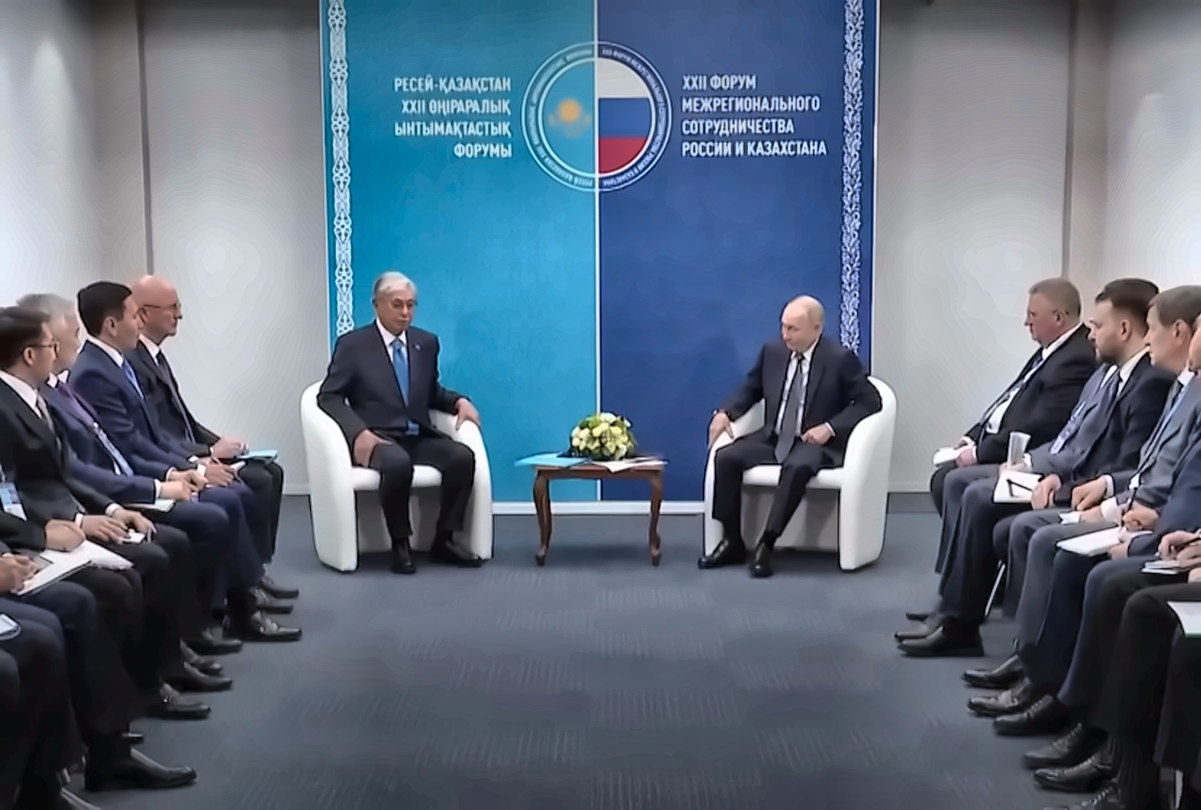
On July 25, 2026, President of Kazakhstan Kassym-Jomart Tokayev, during a visit to Omsk, publicly proposed to his Russian counterpart Vladimir Putin that the two countries «freeze the conflict between Russia and Ukraine» and return to the negotiating foundation laid in Istanbul in 2022 — an approach he called the «Istanbul Formula 2.0.» The statement came before journalists at the start of a bilateral meeting that preceded the plenary session of the XXII Forum of Interregional Cooperation between Russia and Kazakhstan.
Tokayev began by noting that this was not the first time he had found himself relaying diplomatic «signals» from the West: he said he had already informed Putin by phone about contacts «from Europe, from the United States of America» concerning the war between Russia and Ukraine. «People know about our meeting, they know I am supposed to be in Omsk, and asked me to convey,» Tokayev said, adding that «no one knows» the way out of the situation, but that there is a method tested in international practice — putting the conflict «on ice.»
Notably, the Kazakh leader directly rejected the role of mediator between Moscow and Kyiv. «I refuse to be a mediator because I know that Russia is a great country, the Russian people are a great people, and, as they say, they will manage without mediators,» he stated, Interfax quotes Tokayev. The disclaimer spares Astana the reputational risk of acting as arbiter, even as Tokayev simultaneously functions as a channel for Western «signals» — performing the role of mediator in practice while disavowing the label in public.
He went on to repeat a point he has made since the war began: that what is happening is an «interstate conflict,» not a civil war, and that its nature remains «not entirely clear» even in Astana. For comparison, he cited the Karabakh conflict between Azerbaijan and Armenia, whose origins, he said, were «perfectly clear» and rooted deep in history — unlike the war between Russia and Ukraine. The formulation both steers the conversation away from the question of aggressor and victim and reveals that, more than three years into a full-scale invasion, Tokayev still cannot explain its causes — despite Russian propaganda's insistence on the «deep historical roots» of the conflict.
Tokayev framed his call to revive the «Istanbul Formula 2.0» and freeze the fighting — «naturally, under the guarantees of great powers, including Russia,» before moving toward «long-awaited peace» — in humanitarian terms, arguing that the deaths of young people amount to a loss of the «gene pool of the fraternal peoples — Russia and Ukraine,» and that prolonging the war «plays into the hands and brings joy to the opponents of both Russia and Ukraine.» The language of «fraternal peoples» and shared adversaries echoes the Russian narrative that the war is externally orchestrated, while equating the losses and interests of both sides and sidestepping the question of Russia's full-scale aggression against Ukraine.
During the public portion of the meeting, Putin did not respond directly to Tokayev's proposal, only promising to brief him later «in detail» on the situation along the Ukrainian front. That briefing evidently took place behind closed doors: Kremlin spokesman Dmitry Peskov later confirmed to Interfax that Putin had indeed reacted, walking Tokayev through the progress of what Moscow calls the «special military operation.» «Of course [he reacted]. He told him in detail about the special military operation,» Peskov said, according to Interfax.
Peskov made clear that Moscow considers a freeze unworkable under current conditions. «For us, the main condition is that we must achieve our goals,» he stated, reiterating that Russia's terms for ending hostilities «are clear and consistent,» and that the fighting «could stop by the end of the day if the Kyiv regime makes the appropriate decisions.» Kazakhstan had earlier reported on Tokayev's proposal to freeze the conflict and return to the «Istanbul Formula 2.0» as a basis for a peace settlement, with the Kazakh leader adding that the conflict's essence «is not entirely clear to many, including us.»
Fergana Commentary: Tokayev's words cannot be considered in isolation from events of the past week and a half on the Black Sea. From July 17 to 20, the marine terminal of the Caspian Pipeline Consortium (CPC) near Novorossiysk came under a series of drone attacks that damaged tankers, including vessels carrying Kazakh oil from Tengizchevroil and KazMunayGas.
Notably, Moscow itself had already tied this issue to the negotiating agenda on the eve of the Omsk meeting: as Rossiyskaya Gazeta reported, Putin and Tokayev were expected to discuss the strikes on CPC infrastructure, with a Kremlin representative describing the attacks as effectively an assault by Ukraine «on Kazakhstan, Russia, and the United States of America,» since the consortium's shareholders include Chevron and ExxonMobil.
Seen in that light, the proposal to «freeze» the war looks less like a neutral peacekeeping gesture and more like a signal aimed at several audiences at once. For Moscow, it reaffirms that Astana remains a friendly partner. For Washington and European capitals, it demonstrates that Kazakhstan is listening to their «signals» and willing to pass them along. And for Kazakhstan's own economy, the stakes are concrete: as long as attacks on the CPC continue, the pipeline carrying the bulk of the country's oil exports remains at risk, giving Astana a direct interest in any de-escalation of the fighting, more than in simply preserving the status quo.
At the same time, the formula Tokayev proposed — a frozen conflict guaranteed by «great powers, including Russia» — describes not so much a peace agreement as the fixation of the current front line under the patronage of powers whose interests in the war are directly opposed. For Kyiv, which has already dismissed the very metaphor of the «spirit of Istanbul» as dead and consistently insists on negotiations that include Ukraine and are based on internationally recognized borders, such a scheme — voiced, moreover, in Omsk and in Putin's presence — is unlikely to look like an acceptable starting point for dialogue.
This is not the first time Tokayev's public remarks on the war have drawn a sharp response from Ukraine, following both his 2019 comments on Crimea and his 2024–2025 remarks about Putin's «flexibility.» His latest speech in Omsk appears to follow the same pattern: balancing between the role of a conduit for Western «signals» and that of Moscow's closest ally, Tokayev once again chose language that sounds like a call for peace but, in substance, aligns more closely with Russia's negotiating position — a position the Kremlin, through Peskov, has now confirmed it has no intention of softening.