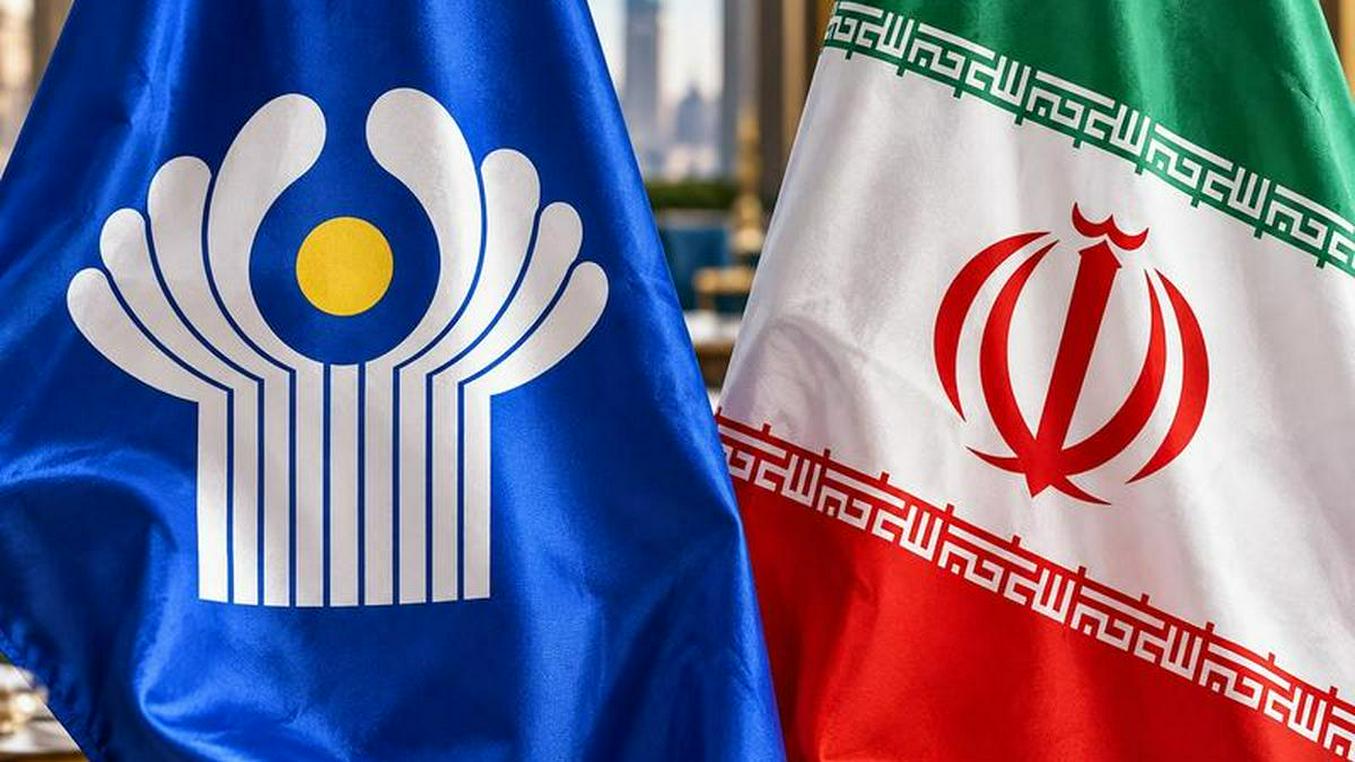
Iranian President Masoud Pezeshkian has proposed creating a «CIS+1» format, a permanent mechanism for dialogue between Tehran and the Commonwealth countries. He made the proposal on October 9 at a meeting of the CIS Council of Heads of State in the Avaza tourist zone in Turkmenistan, Tehran Times reported.
The proposal's practical significance is limited for now: in the 35 years whose anniversary the summit marked, the Commonwealth has become neither a common market nor a union with strong institutions. But for Iran, which has been at war with the United States and Israel since late February, as The Daily Star notes, it is yet another platform in the post-Soviet space. For the CIS, it is a chance to show that outside partners are reaching out to it.
Another track is also important for Tehran: the Eurasian Economic Union. Iran already has a free trade agreement with the bloc, has received observer status and has publicly declared its aim of full membership. If that scenario is ever realized, the EAEU would for the first time extend beyond the former USSR, its population would grow by nearly half, and the Union's territory would stretch from Nakhodka to the Persian Gulf.
Why Iran Wants the CIS
Pezeshkian came to the summit as a special guest of Turkmenistan, which chairs the Commonwealth, and took part in a meeting of CIS leaders for the first time, Turkmenistan's Foreign Ministry said. He named trade, energy, transport, investment, mining, technology, water management and the environment, tourism, and scientific and cultural ties as areas for the future «CIS countries + Iran» format. Iran's accession to the Commonwealth is not on the table: Tehran is proposing an external format of engagement.
The framework for such participation emerged only recently. Kazakh President Kassym-Jomart Tokayev proposed the «CIS Plus» format at the summit in Moscow in October 2024, BelTA recalled. A year later, on October 10, 2025, the heads of state approved it in Dushanbe as a platform for cooperation between the Commonwealth and other countries and organizations, according to a decision published by the CIS Executive Committee. How the format's purpose was explained while the document was being prepared is telling. CIS Deputy Secretary General Nurlan Seitimov spoke of «promoting a positive image of the Commonwealth on the world stage» and expanding ties with the UN and regional organizations, the 24.kg agency reported.
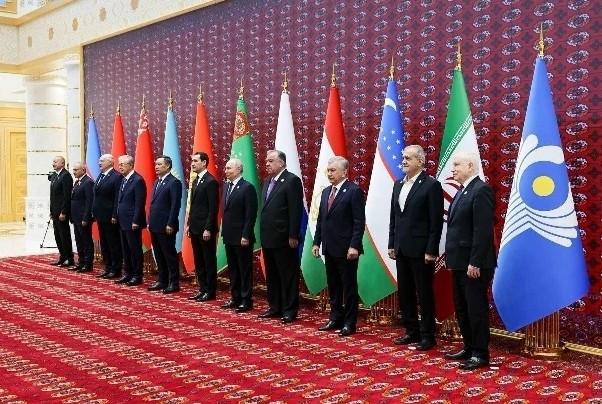 Leaders of the CIS countries and Iran. Photo from the organizers' social media
That wording accurately describes the political side of what is happening. In terms of integration depth, the CIS remains a loose construct. It has a 2011 free trade zone treaty, but no supranational economic regulator, common customs territory, single external tariff or common labor market, and its members retain far more freedom than those of the EAEU. The Commonwealth works primarily as a platform for political dialogue and sectoral coordination, from security to transport and humanitarian ties.
For Iran, that may be enough. The format gives Tehran another channel for working simultaneously with Russia, Central Asia, Azerbaijan and Armenia, and it fits the country's policy of recent years: membership in the SCO and BRICS and closer ties with Moscow and Asian capitals. The war gives this practical meaning.
As long as the U.S. naval blockade of Iranian ports remains in place, overland and Caspian routes to the north are becoming especially important for Tehran.
For Moscow, Iran's interest in the CIS matters primarily as a symbol. Post-Soviet structures have long been losing members: Georgia left the Commonwealth back in 2009, and Moldova will cease to be a member on April 8, 2027, Foreign Minister Mihai Popșoi said. Against this backdrop, the interest of a large state that was never part of the USSR allows Moscow to show movement in the opposite direction, if only at the level of political optics.
Iran's economic interest lies elsewhere.
EAEU: From an Interim Agreement to Free Trade
Iran's treaty relations with the EAEU began on May 17, 2018, when the parties signed an interim agreement leading to the creation of a free trade zone. It took effect on October 27, 2019, and granted preferences only for a limited list of goods, the Eurasian Economic Commission says.
Iran's trade with the Union grew from $2.4 billion in 2019 to $6.2 billion in 2022, the EEC calculated. It would be wrong to attribute all of that growth to a single agreement: prices, sanctions and the restructuring of Russia's foreign trade all played a role. Nor was growth steady afterward. Trade fell to $5.2 billion in 2023, the outlet BM.GE reported, citing the EEC, and rose to $5.9 billion in 2024, EEC Management Board Chairman Bakytzhan Sagintayev said.
Even so, the parties pressed on. A full-format free trade agreement was signed in St. Petersburg on December 25, 2023, and took effect on May 15, 2025. It eliminates duties on about 90% of tariff lines, which account for around 95% of mutual trade, Belarus's Ministry of Economy says. The average Iranian duty on goods from the EAEU fell from 20% to 4.5%, the EEC reported. Russian Deputy Prime Minister Alexei Overchuk named exporters of rolled steel, iron ore, pipes, nonferrous metals, paper, grain and vegetable oils as the main beneficiaries, the Interfax agency reported. Iran, for its part, has expanded access for its agricultural and industrial products to the markets of Russia, Kazakhstan, Belarus, Armenia and Kyrgyzstan.
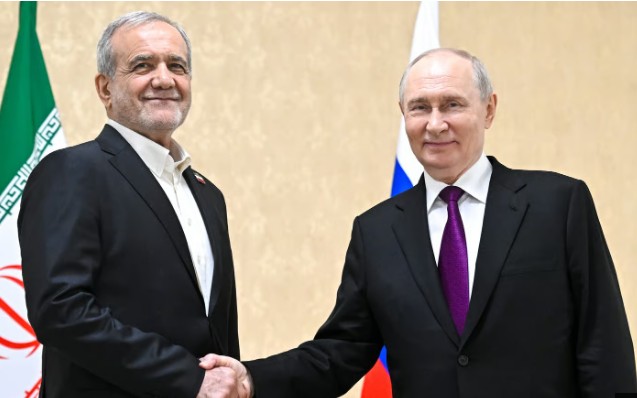 Pezeshkian and Putin. Photo: Sergey Bobylev / EPA / SPUTNIK
Tehran took the next step even before the new agreement took effect. Iran requested observer status in May 2024, and the Supreme Eurasian Economic Council granted it on December 26 of that year, BelTA reported. An observer may attend meetings of the Union's bodies by invitation and receive non-confidential documents, but has no right to take part in decision-making.
In the summer of 2025, Tehran began to talk of more. First Vice President Mohammad Reza Aref, en route to a meeting of the Eurasian Intergovernmental Council in Cholpon-Ata on August 14–15, said the government was working on mechanisms that would open the way to Iran's permanent membership in the Union, Press TV reported. Aref himself acknowledged that joining an economic union is harder than joining a political or cultural organization, according to Iran News Daily. There is no official accession process, Iran remains an observer, and there is no basis to speak of imminent EAEU enlargement. But the idea is already being voiced at the level of the country's leadership.
From Nakhodka to the Persian Gulf
The scale of possible enlargement is incomparable with the previous one: Armenia and Kyrgyzstan joined the Union in 2015, and their combined population today is about 10 million. The five EAEU countries have about 186 million people, according to an EEC statistical yearbook. Iran's population exceeds 93 million according to a UN estimate, although the Statistical Center of Iran puts it at about 87 million. Together, that makes 270–280 million people.
The geography would change as well. Russia gives the EAEU access to the Pacific Ocean; Iran would give it access to the Persian Gulf and the Gulf of Oman. The main practical significance of such a configuration lies in transport.
Iran has long sought to become a southern route for Russia and Central Asia: branches of the International North–South Transport Corridor run through its territory. The eastern branch links Kazakhstan with Iran by rail through Turkmenistan, the western branch runs through Azerbaijan, and another route crosses the Caspian.
A seamless system is a long way off. The western branch depends on Azerbaijan, the eastern on Turkmenistan, and a gap remains within Iran itself: the 162-kilometer Rasht–Astara section has still not been built. Signing of the executive contract for its construction has been postponed until the end of 2026 because of the fighting, Kommersant reported, citing Iran's ambassador to Russia, Kazem Jalali. The southern ports, for which the corridor is being built, are currently under a U.S. blockade. Formal accession by Iran would therefore not automatically create a single transport space.
But it would sharply raise the importance of the southern route for the Union. Iranian ports would become the infrastructure of a member state, and developing routes to the Persian Gulf would shift from cooperation with an external partner to an internal task of the bloc.
What Full Membership Would Bring
Iran already enjoys a favorable trade regime, so the main question is what membership would add to the current free trade zone. It could add a great deal. The EAEU provides for the free movement of goods, services, capital and labor, and citizens of member states can work in other Union countries without work permits. For a country of nearly 90 million people, that is a completely different level of integration. Tehran would gain a vote in decision-making and join the common system of technical regulation, customs legislation and foreign trade policy.
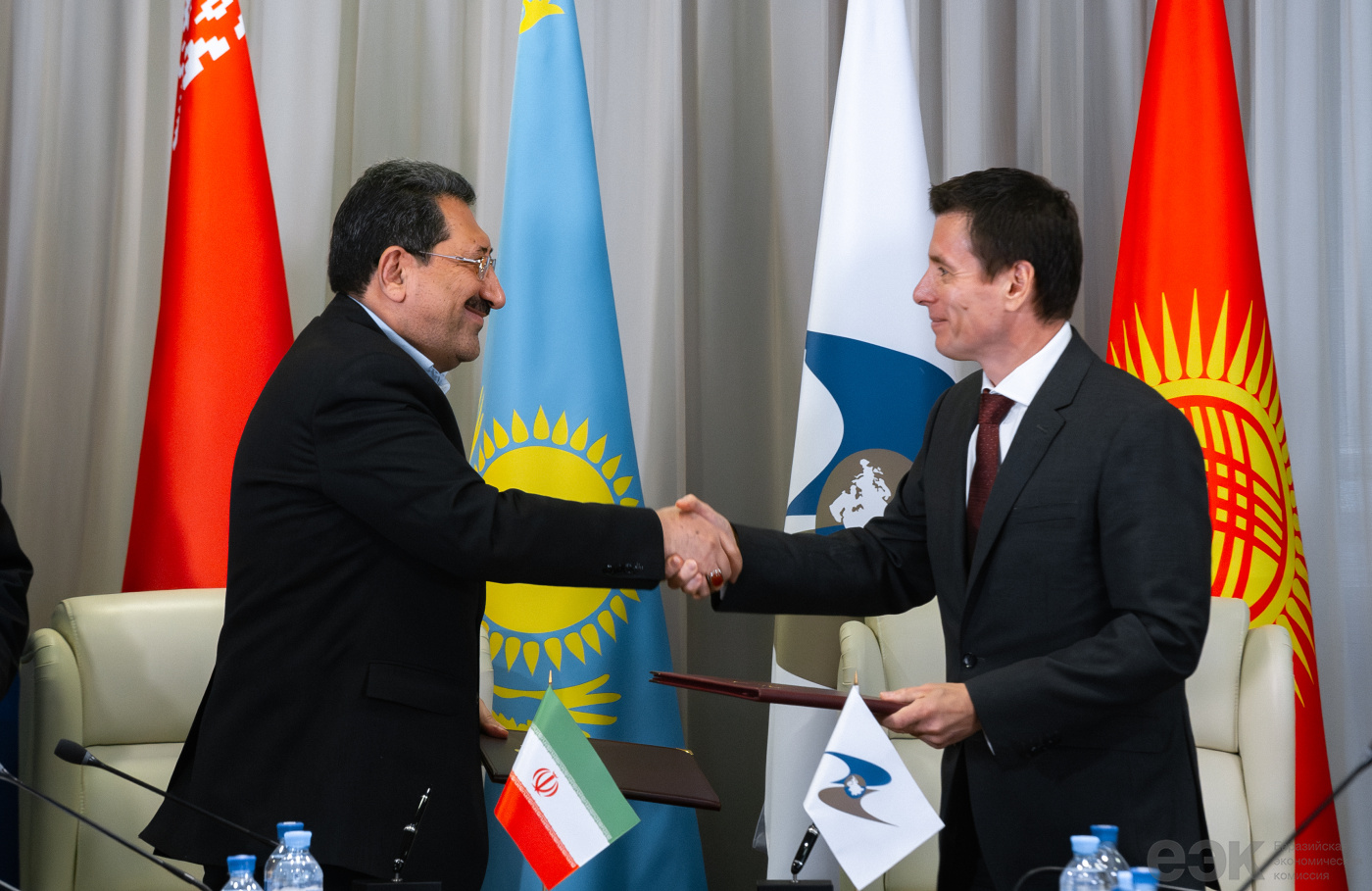 Iran's Minister of Industry, Mines and Trade Mohammad Atabak and EEC Minister for Customs Cooperation Ruslan Davydov. Photo: dknews.kz
There is also an energy dimension. Iran holds some of the world's largest oil and gas reserves, and one bloc would include three major hydrocarbon producers: Iran, Russia and Kazakhstan. That opens opportunities for swap supplies, petrochemicals, power generation and transport, but it does not change the fact that all three countries compete for some of the same markets.
Regulation is an even thornier issue. Iran has spent decades building its economy under sanctions, currency restrictions, a large state role and its own tariff protection. Membership would require rewriting a significant body of legislation and adopting common rules, including the single external tariff.
Finally, there is sanctions risk. Russia and Belarus are themselves under sweeping Western restrictions, but Kazakhstan, Armenia and Kyrgyzstan are far more closely tied to the international financial system. Deeper integration with Iran would increase the number of transactions in which banks and companies must account for U.S. and European sanctions and the threat of secondary restrictions. The war makes this risk more acute: Washington continues to impose sanctions on networks that ship Iranian oil, Gulf News reports.
Does Iran Need to Join?
Tehran's current position is already advantageous: free trade on almost 90% of tariff lines, observer status, work with the EEC and joint transport projects, all while keeping its own trade and currency policy. Membership would bring more rights and deeper access to the common market, but at the price of adopting a significant share of the Union's rules. The decision would require the consent of all five EAEU members, a formal procedure and adaptation of legislation, so a long time may pass between Aref's statements and actual accession.
This is where the difference between the two Iranian tracks becomes clear. The CIS gives Tehran a convenient political platform, and gives the Commonwealth and Moscow a chance to show that Eurasian structures attract partners outside the former USSR even as their own members leave. The EAEU is a different matter of scale: free trade is already in force, observer status has been obtained, and the first vice president has declared an intention to join.
If that step is ever taken, the EAEU will for the first time admit a state from outside the former USSR, grow its population by nearly half and reach the Persian Gulf. The phrase «from Nakhodka to the Persian Gulf» would then cease to be a political metaphor and become a description of the Union's borders. For now, its fate depends not only on talks in Moscow and Tehran but also on how the war around Iran ends.
-
 13 October13.10A Nepali Lesson for Rogun111 groups urge the World Bank to freeze funding for high-mountain dams after Nepal's deadly flood, naming Tajikistan's Rogun among projects to drop
 -
 01 October01.10Yields of 6–7 Tonnes per HectareUzbekistan is expanding a Chinese cotton-growing method to a third of its cotton fields
 -
 17 September17.09Summit of Morning FreshnessCritical minerals, artificial intelligence — what else was discussed at the “Central Asia–Korea” meeting
 -
 16 June16.06A Dam Named After One FamilyThe world's tallest dam is being built in Tajikistan on empty reserves and other people's loans
 -
 13 May13.05Video Revolution in the World of ReviewsHow an Uzbek entrepreneur is building a “YouTube for business” on the Western market.
 -
 06 May06.05ADVES CEO Marina Shabalina: Business reputation is key for companies from Central Asia
-

Swiss court opens proceedings against the daughter of Uzbekistan's former president — riddled with gaping procedural gaps
-
What lies behind Kiriyenko’s visit to Uzbekistan?
-

The story of the persecution of a Kazakh priest who entered into open conflict with the Russian Orthodox Church
-
What China Can Offer Central Asia in the “Green” Economy