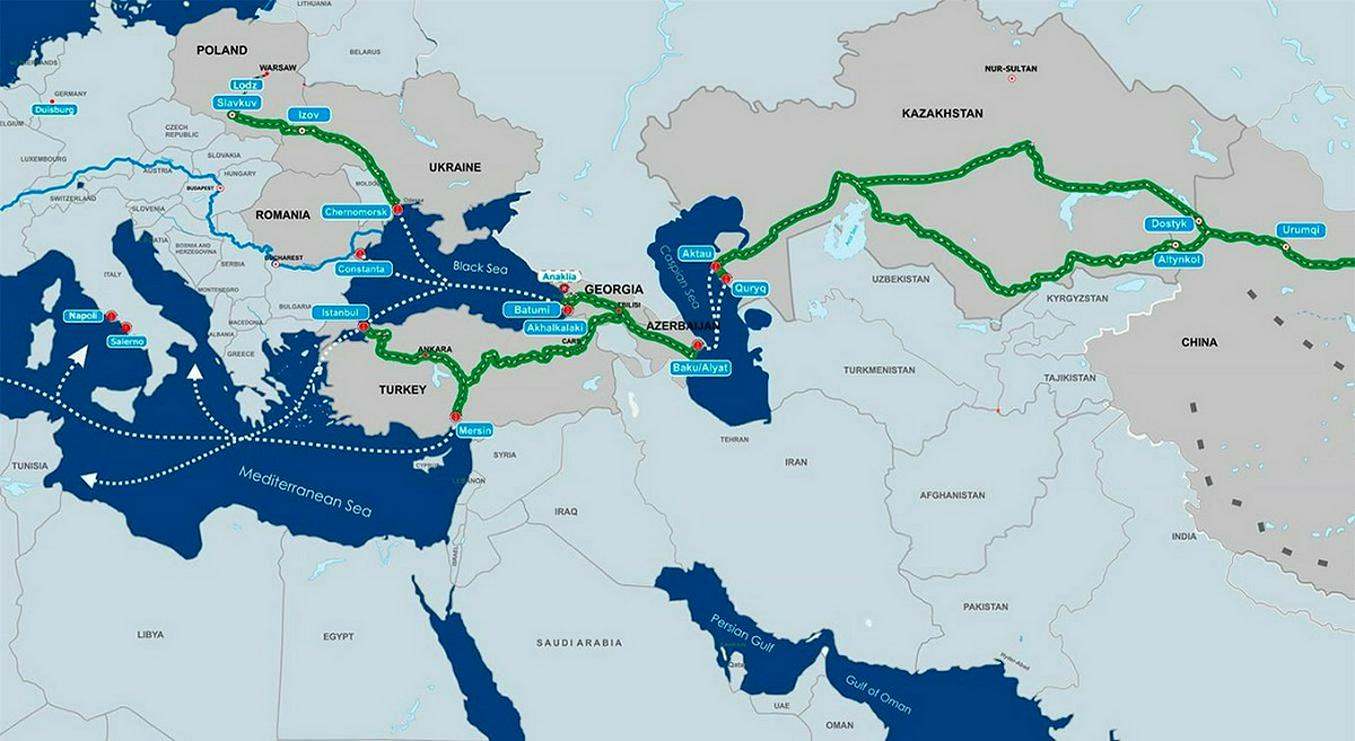
Without the necessary measures, port infrastructure on the Caspian Sea could reach its limits as early as 2027–2028, according to an article by the Russian industry news agency RZD-Partner.ru.
The article says the Caspian Sea is the main bottleneck of the Trans-Caspian Transport Corridor (TCTC), which is seen as an alternative route between China and Europe. According to World Bank estimates, silting has cut the effective capacity of Caspian ports by 40–50% below their potential. A shortage of vessels and delays in cargo handling are further holding back the route's development.
Today, the TCTC mainly carries grain, coal, iron ore, fertilizers and other bulk cargo. In the long term, however, the route's prospects depend on container shipments, including electronics, consumer goods and perishables.
Attracting such cargo will take more than expanding railway capacity. Shippers need predictable delivery times, transparent tariffs and coordinated work among all parties involved in transport. For now, border delays, waiting for vessels and additional transshipments raise both the cost and the duration of delivery.
Transit along the Middle Corridor from the Chinese border to the European border is estimated to take 12–15 days. By comparison, shipping along the Northern Corridor through Russia takes 7–10 days, while the sea route via the Suez Canal takes 30–35 days but is cheaper.
The TCTC's main advantage is the chance to diversify routes and reduce dependence on transit through Russia. But geopolitics alone is not enough if shipments remain expensive and unpredictable, the author writes.
The Middle Corridor still lags behind competing routes in speed, cost and reliability. To become more competitive, the article says, total logistics costs must be cut by at least 30–40%, regular container block trains must be established, and a unified T3 transport document must be introduced. Without these steps, building up infrastructure capacity alone does not guarantee growth in cargo flows, the article states.
ℹ️ The Trans-Caspian route links the railway infrastructure of Kazakhstan, the Caspian seaports, the transport networks of Azerbaijan and Georgia, and the connections to Turkey and Europe. On the eastern section, the main flows from China pass through the Khorgos and Dostyk border crossings and then head to the ports of Aktau and Kuryk.
Onward transport depends on vessel availability, the condition of port infrastructure and permissible draft. On the western shore of the Caspian, cargo is handled by the port of Baku and other transport hubs in the region. A shortage of ferries and restrictions caused by shallowing waters increase waiting times and costs.
Logistics expert Alexei Novikov believes that without modernizing ports and renewing the fleet, the Caspian will remain the main constraint on the corridor's development. According to the World Bank estimates cited in the article, port infrastructure could reach its limits as early as 2027–2028.
There are constraints on the western leg as well. Transfers between railway networks with different track gauges require additional operations, which add time and cost to shipments. The route's capacity is also limited by certain sections of railway infrastructure, including on the segment through Turkey.
Developing the route could benefit not only the transit sector but also the economies of the participating countries, through investment in logistics, manufacturing and services around transport hubs. But this effect will not materialize automatically: infrastructure modernization, digitalization of procedures and coordination among states are required, the author concludes.