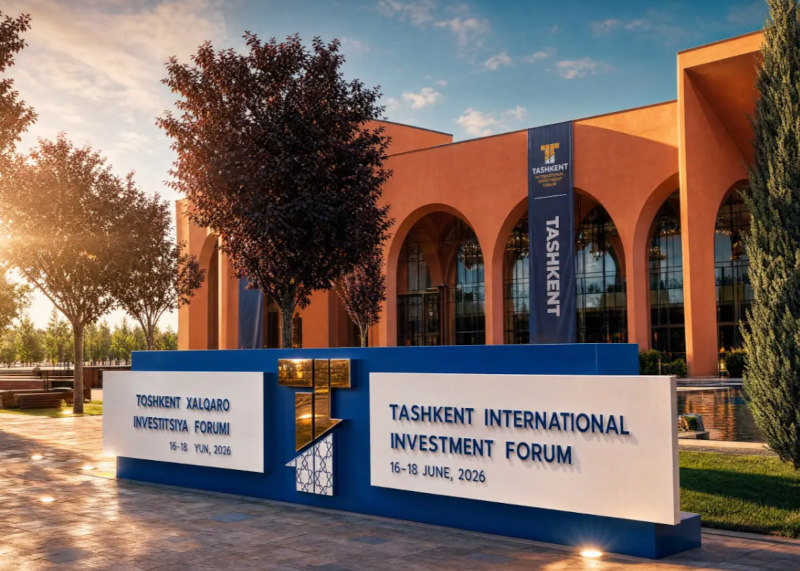
The fifth Tashkent International Investment Forum (TIIF-2026), held in Uzbekistan’s capital on June 16–18, concluded with a record-setting outcome: 166 investment agreements worth $43.1 billion were signed. The results, summarized by the Ministry of Investments, Industry and Trade of Uzbekistan, “demonstrate the country’s shift from showcasing potential to building concrete long-term partnerships, sectoral projects, and predictable business conditions.”
Scale and Structural Evolution of the Audience
Over four years, international participation in TIIF has more than tripled. In 2026, total attendance exceeded 10,409, including 3,802 foreign delegates from 102 countries (up from 1,050 in 2022, 1,142 in 2023, 1,874 in 2024, and 2,022 in 2025).
The most notable qualitative shift was in the audience structure:
✅ The forum hosted 3,145 representatives from real-sector companies, 1,480 more than a year earlier.
✅ Participants included global corporations and financial institutions such as BlackRock, JPMorgan Chase, Citibank, Visa, Franklin Templeton, Standard Chartered, London Stock Exchange Group, Bank of China, BP, Masdar, ACWA Power, Airbus, John Deere, Meta, Coca-Cola, DP World, and AD Ports Group.
✅ The combined assets under management of represented companies are estimated at $42 trillion, underscoring sustained interest from major capital in Uzbekistan’s infrastructure and industrial sectors.
Political participation also expanded significantly: the number of government representatives rose from 26 to 76. The central event was a plenary session chaired by President Shavkat Mirziyoyev, attended by senior officials from Albania, Russia, Azerbaijan, Belarus, Kazakhstan, Kyrgyzstan, and Tajikistan.
Expanded Program and Sector Focus
TIIF-2026 featured 79 events, including 34 panel discussions, 8 investment pitch sessions, and 7 major bilateral business forums involving the United States, China, South Korea, Turkey, Azerbaijan, Saudi Arabia, and the UAE.
Key discussions focused on strategic sectors driving economic modernization:
✅ Renewable energy and critical minerals
✅ Transport corridors and logistics
✅ Artificial intelligence and digital governance
✅ Islamic finance
✅ Agribusiness and food security
Alongside the forum, the second Exhibition of Uzbekistan’s Investment Potential presented the country’s capabilities in geology, engineering, IT, energy, artificial intelligence, and manufacturing, as well as agriculture—linking investment opportunities with tangible technological capacity.
Institutional Dialogue and Investment Tools
The forum’s practical impact is reinforced by evolving institutional mechanisms:
✅ The Council of Foreign Investors expanded from 54 to 85 companies across 19 countries and 23 industries; 21 initiatives were developed, 8 legal acts adopted, and 16 working groups established.
✅ The planned Tashkent International Financial Center aims to provide a transparent investment environment based on English law, free capital movement, multi-currency operations, and preferential conditions for fintech, digital assets, and green finance.
The official agenda was complemented by informal networking events, including the TIIF OPEN tennis tournament and the Silk Road Night Run marathon, which attracted more than 500 participants from over 16 countries.
Global Media Presence
International media interest nearly doubled in 2026. TIIF was covered by 209 foreign journalists from 41 countries, representing 123 outlets. On-site coverage included Bloomberg, Reuters, Nikkei, Euronews, BBC News, CGTN, TRT, The Independent, and Xinhua, reinforcing the forum’s status as a leading global investment platform with a strong practical focus.