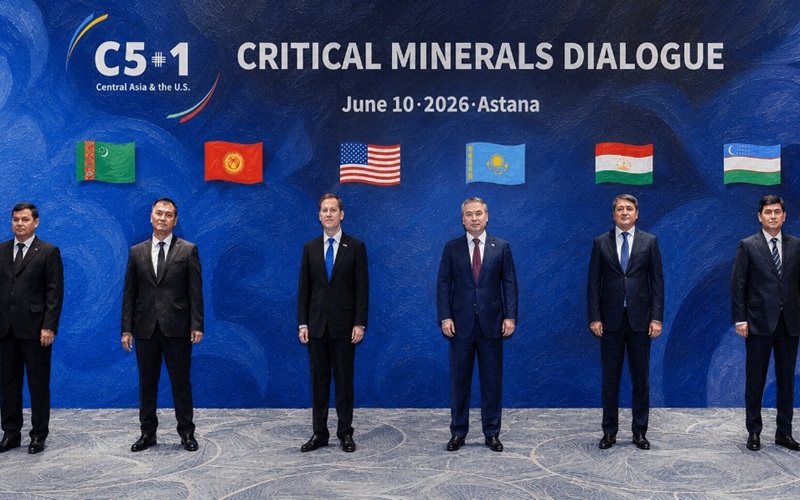
 C5+1 Dialogue Photo from the organizers' press service
On June 10, a fresh round of US–Central Asia talks on critical minerals in the C5+1 format took place in Astana. US Special Envoy for South and Central Asia Sergio Gor said Washington intends to engage more actively with the region, which it views as an important hub for global trade, transport connectivity, and secure supply chains, Timesca.com reports.
During his remarks, Gor noted that Central Asia «has not received the attention from the United States it deserves,» and that the administration of Donald Trump has decided to change that.
«This region matters to us. We want to be engaged in this region's affairs, and we want to find mutually beneficial solutions for the United States and your countries,» Gor said.
He added that critical minerals have become one of the central strands of this engagement, as they are essential for infrastructure, advanced technologies, industry, and national defense.
«Our economic security depends on the ability to diversify access to critical minerals. Ensuring reliable access to these materials requires not only expanding production but also building sustainable, transparent, and market-based supply chains in close partnership with reliable partners,» Gor said.
He also highlighted the role of the US International Development Finance Corporation, saying it is preparing to «invest and build» in the region and sees potential in critical minerals, telecommunications, and trans-Caspian infrastructure. According to Gor, the corporation sees «the potential to turn the region's abundant deposits of critical minerals into the basis for a new wave of industrialization."
«President Trump understands the importance of Central Asia for global trade, connectivity, and critical minerals,» Gor said.
Kazakhstan used the opening of the meeting to present itself not only as a country rich in mineral resources but also as a future hub for the processing, technology, and transport of critical mineral supply chains.
Kazakhstan's Minister of Industry and Construction, Ersayyn Nagaspaev, called the Astana dialogue a continuation of the Kazakhstan–US track on critical minerals launched during President Tokayev's visit to Washington in November 2025.
«One of the practical results of those talks was the signing of a memorandum of understanding with the US government in the field of critical minerals,» Nagaspaev said.
He also cited cooperation with Cove Capital on tungsten projects in Kazakhstan as a practical extension of the agreements between the two countries. The Times of Central Asia previously reported that Cove Kaz had acquired a controlling stake in Severniy Katpar LLP, which holds licenses for the Severniy Katpar and Verkhniye Kayrakty tungsten projects in the Karaganda region. The minister added that Kazakhstan regards critical minerals as one of the key priorities of its industrial policy and long-term economic development.
«Kazakhstan has over 9,500 mineral deposits, including more than 100 containing rare and rare earth metals. We invite American companies to take an active part in their exploration and development. Since 2018, investment in geological exploration has tripled, exceeding $1 billion,» Nagaspaev said.
He also tied the critical minerals agenda to the Trans-Caspian International Transport Route and the broader Middle Corridor, which Kazakhstan is promoting as a route linking Asia and Europe without relying solely on traditional northern corridors.
It is also worth noting that the Cove Kaz Capital project to develop the Severniy Katpar and Verkhniye Kayrakty deposits jointly with the national company Tau-Ken Samruk has drawn considerable attention. The Financial Times reported that Donald Trump's sons invested in a company linked to the project, raising questions in the US about a possible conflict of interest. However, no public evidence of their influence on securing the project or obtaining government support has been provided.
Critical minerals are of major importance for the «green» economy and the transition to renewable energy. Among other uses, they go into batteries for electric vehicles, machine parts, and smartphones. Critical minerals include lithium, cobalt, nickel, graphite, neodymium, samarium, and others.