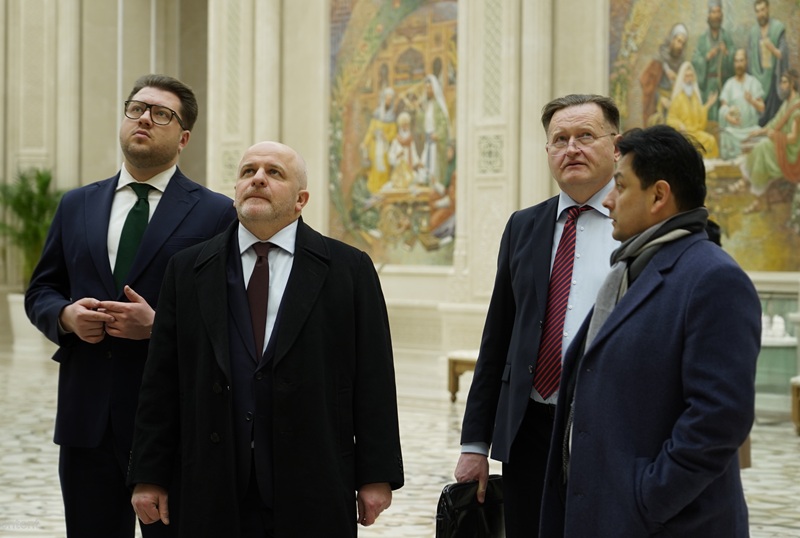
 Polish lawmakers. Photo: cisc.uz.
A delegation of Polish lawmakers led by Paweł Kowal, chair of the Foreign Affairs Committee of the lower house of parliament, has visited Uzbekistan’s Center for Islamic Civilization. The Center’s press service reported the visit.
The guests toured the museum exhibitions, including the halls devoted to the First and Second Renaissances, the pre-Islamic period, New Uzbekistan, and the Hall of Qurans.
Paweł Kowal described the museum as a distinctive space, emphasizing the modern approach combined with a careful and respectful presentation of the country’s history.
“In my view, the main message of this place is very simple: Uzbekistan is an ancient civilization, part of a culture that existed long before many modern European states emerged. The country’s citizens and the peoples who live here are the true masters of this land. It is on the basis of deep and rich religious and cultural traditions that they are building modern life and today’s reality. And that is the most important thing. I think everyone who visits the museum quickly understands that Uzbeks live on their own land and are not obliged to prove anything to anyone. They simply make a significant contribution to global processes, relying on their traditions, historical heritage, and values. This place tells history and shows the world the people’s distinct identity, independence, and cultural legacy,” Kowal said.
Andrzej Dycha, president of the Polish Investment and Trade Agency, called the Center a place that brings together millennia of history forming the foundation of Uzbekistan.
“The Center makes a strong impression and clearly demonstrates the depth of Uzbekistan’s historical foundations. That is precisely why the Uzbek people are held in high regard in Poland and across Europe. The main reason is their extraordinarily rich historical and cultural heritage. In my view, this rich historical ground directly influences the development of modern Uzbekistan, including the rapid growth of Tashkent. There is a strong link between past and present: the achievements of the past are reflected in today’s reforms and development processes,” Dycha said.
The Center for Islamic Civilization is being built in Tashkent next to the Hast-Imam complex. Designed in the style of medieval architectural monuments, the building features four 34-meter-high portals and a central dome rising 65 meters. It includes a Hall of the Quran, a 460-seat conference hall, and a museum whose exhibitions cover Uzbekistan’s entire history—from pre-Islamic times to the present day. The Center is intended to serve as a platform for studying ancestral heritage and reinterpreting it in a contemporary context, in cooperation with the International Islamic Academy of Uzbekistan and research and educational institutions worldwide. The opening of the Center is scheduled for spring 2026.