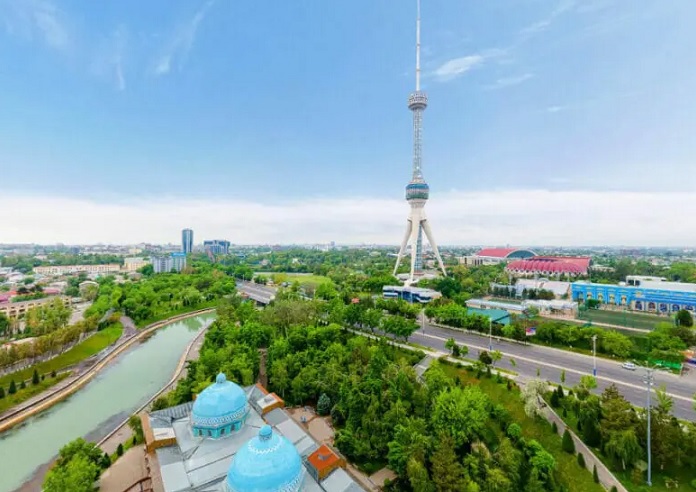
 City administration building. Photo: kursiv.media.
President of Uzbekistan Shavkat Mirziyoyev has instructed the khokimiyat (city administration) of Tashkent to attract $20 billion in foreign direct investment over the next two years, including $9 billion in 2026. The targets were announced at a meeting on the socio-economic development of the capital, according to the president’s press service.
It was noted that the city’s permanent population is growing by an average of 100,000 people a year and, according to forecasts, will exceed 3.5 million by 2030. At the same time, the authorities plan to increase gross domestic product to $52 billion and nearly double per capita income.
Achieving these goals will require more active work by the city’s khokim, his deputies, and the heads of all 12 districts. Approaches to housing development, transport, energy, education, and service infrastructure are to be revised. In this context, a proposal was approved to appoint advisers to the mayor with experience managing large metropolitan areas.
Mirziyoyev announced that 2026 will be designated the “Year of Accelerated Development and Income Growth” for Tashkent, with a large-scale program to be launched to support this initiative.
In Sergeli, Yangihayot, and Bektemir districts, the focus will be on high-tech industry and logistics. An agrologistics and warehouse complex valued at $70 million is scheduled to be commissioned there.
Projects worth $2 billion are being implemented in the Yangi Avlod industrial zone, covering electrical engineering, textiles, automotive manufacturing, and the food industry. The zone will be expanded by 640 hectares, making it possible to accommodate new enterprises with investments of about $3 billion.
In Uchtepa, Chilanzar, Yakkasaray, Shaykhantahur, and Almazar districts, priority areas include services, the creative economy, design, and tourism. In Mirzo Ulugbek, Yunusabad, Mirabad, and Yashnabad districts, projects totaling $1 billion are planned in artificial intelligence, startups, fintech, finance, healthcare, and education.
As the president noted, 26 streets have been converted to round-the-clock operation this year, resulting in the opening of 1,200 retail and service outlets and the creation of 5,000 jobs. In 2026, another 18 such streets are to be established.
The meeting also highlighted the need to build 75 schools, the same number of kindergartens, and 23 sports facilities. District heads have been instructed to construct one of these types of facilities each year in their respective areas using independently raised funds. An additional 15 schools and kindergartens, along with 11 sports facilities, will be built under the investment program.
Attention was also paid to education quality. Under a dedicated project, 1,500 students in grades 7–11 have been selected for intensive training in IT, medicine, business, and engineering. Depending on student performance, teachers’ salaries can reach up to 20 million soums ($1,600). The task has been set to expand the number of such schools to 33 by 2027.
The meeting also reviewed recent results. Over the past nine years, more than $20 billion in foreign direct investment has been attracted, and about 5,000 major projects have been implemented.
During this period, the capital’s economy has grown 2.5 times and is expected to reach $27 billion this year. Per capita income will increase from $4,400 to $8,600.
As a result, the poverty rate in Tashkent is projected to fall from 7.3 percent at the beginning of the year to 1 percent, while unemployment is expected to decline from 4.5 percent to 3.5 percent—levels described as natural for the city.