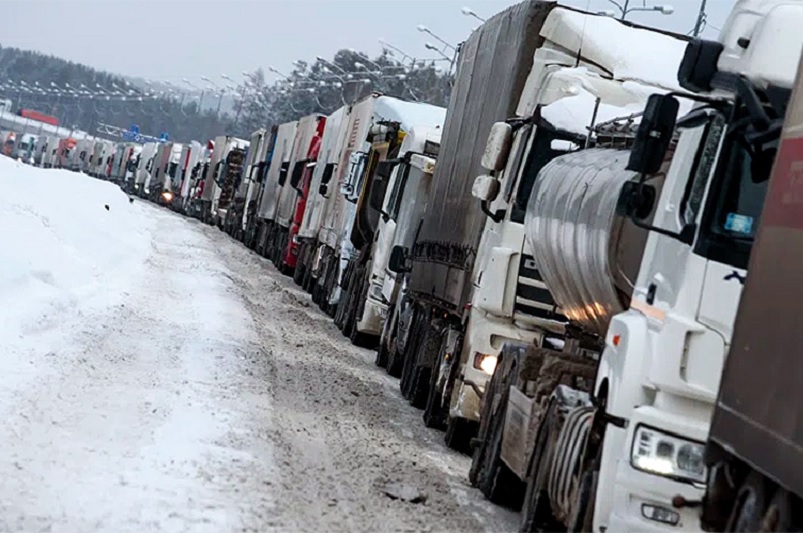
 Photo from ura.news website
Russia will tighten customs control on a permanent basis as part of efforts to “whiten” (legalize and formalize) the economy and protect its domestic market from unfair imports, including those entering from member states of the Eurasian Economic Union (EAEU). This was stated by Russian Deputy Prime Minister Alexey Overchuk at an integration forum held during Russian Business Week, Interfax reports.
According to the official, Russia maintains an open customs border with its EAEU partners, which allows goods to enter the country that create unfair competition for the domestic market. “We are determined to take very tough measures to stop this unfair practice,” Overchuk emphasized.
As part of this effort, Russia has launched in 2026 a system for confirming the expected delivery of goods (SPOT). Under this system, an importer must confirm the conclusion of a supply contract for goods from an EAEU member state and properly оформить the relevant documentation.
In September 2025, “in order to prevent the illegal import and export of goods and to monitor their transit,” the Federal Customs Service was instructed to strengthen the work of mobile inspection groups along the Russian-Belarusian and Russian-Kazakh sections of the state border.
“This is not some temporary campaign,” Overchuk stressed. “We will continue this control on a permanent basis. Some tried to wait it out on the Kazakh side of the border, expecting reduced scrutiny. There will be none. This is our clear position, and we will adhere to it.”
Inspections are carried out in cooperation with territorial units of the Interior Ministry, the National Guard, the Border Service of the FSB, Rosselkhoznadzor, Rospotrebnadzor, and Rostransnadzor. “In 2025, mobile groups identified more than 9,000 vehicles transporting 137,000 tons of goods in violation of Russian legislation,” the deputy prime minister said.
At the same time, Russia has stepped up its fight against “gray” certificates issued in EAEU countries without proper expert examination.
“What did we see? When we began tightening control measures domestically, certain decisions shifted to the platforms of our partners in the Eurasian Economic Union. Products entering our market on the basis of such documents not only create unfair competition for Russian producers but also pose a danger to consumers. (…) In order to protect the domestic market from counterfeit goods, at the end of 2025 state control bodies and Rosakkreditatsiya were granted the authority to suspend certificates and declarations issued in EAEU countries, and this work has already begun,” Overchuk noted.
He also recalled that from February 11 the EAEU began applying electronic navigation seals during transportation. Their use “should serve as an obstacle to goods that should not be on our domestic market.”
The EAEU comprises five states: Russia, Kazakhstan, Kyrgyzstan, Belarus, and Armenia.
Commenting on Overchuk’s statement, Kazakh political analyst Marat Shibutov questioned how the establishment of permanent customs control aligns with the EAEU’s founding documents.
“Was this agreed with the partners? If not, what retaliatory measures might follow? Integration is not a one-way game. Belarus and Kazakhstan are important trade partners, especially under unprecedented sanctions pressure. It appears that in this case short-term fiscal goals are being prioritized over long-term integration objectives,” he wrote on his Telegram channel.
Last autumn, multi-kilometer traffic jams of trucks formed at the Kazakhstan–Russia border. Market participants described them as record-breaking, with between 2,500 and 15,000 trucks stuck on different days. The customs authorities of the two countries blamed each other for the situation. Eventually, the Russian Federal Customs Service stated that the cause was unscrupulous business operators: truck drivers planning to import goods in violation of regulations allegedly avoided crossing the border and waited for further instructions from cargo owners. The Kazakh side attributed the situation to Russia’s stricter controls.
The transport collapse nearly halted the western route for cargo deliveries from China to Russia. To stabilize the situation, Moscow introduced a simplified border-crossing procedure for freight in October, which remained in effect until the end of 2025.