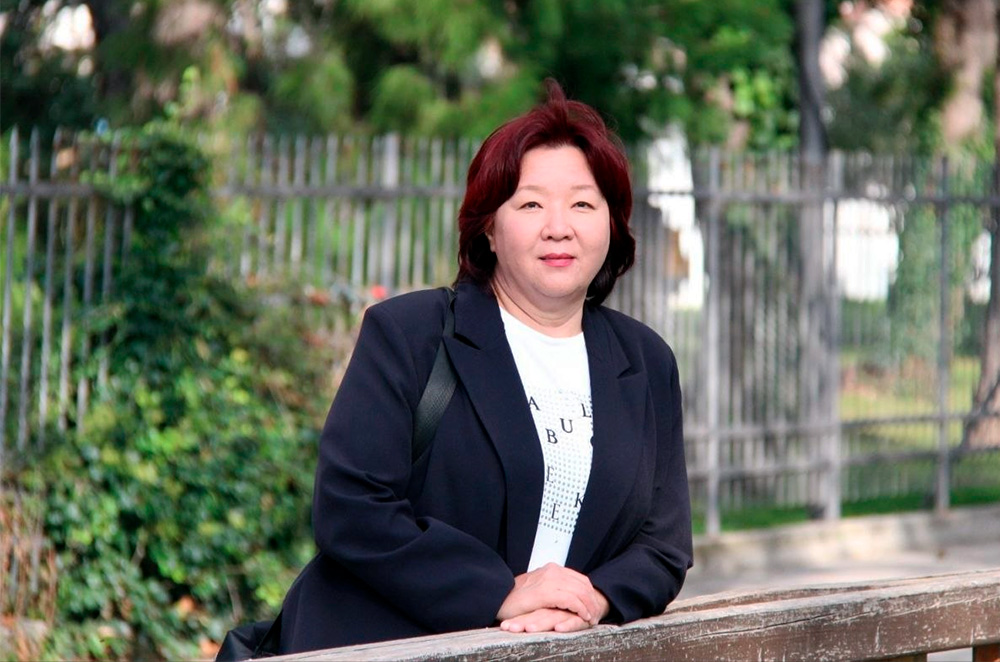
 Dina Tansari. Photo courtesy of her personal archive
On the tenth anniversary of Kazakhstan’s NeMolchi movement, its founder, Dina Tansari, speaks about turning personal trauma into advocacy, confronting a resistant justice system and taking the campaign international.
Kazakh human rights activist Dina Tansari says a decade of campaigning against violence has changed the way her country talks about abuse, even as the institutions meant to protect victims continue to fail them.
On July 9, 2026, the movement she founded announced the launch of the NeMolchi Network, bringing together initiatives in Kazakhstan, Georgia and Montenegro. The expansion marks ten years since Tansari, also known as Dinara Smailova, publicly disclosed that she had survived rape and urged other women not to remain silent.
“When women are raped, tortured and killed on a massive scale, it is not one family’s private problem,” she told Fergana.
From personal trauma to public action
Tansari was 20 when former classmates drugged and raped her. She initially blamed herself and later attempted suicide twice. For years, she refused to discuss what had happened.
Therapy, which she began 25 years later, helped her understand that she was not responsible for the attack. She says the shame she had carried gave way to anger and a determination to help others.
In 2016, Tansari published a post about her experience with a simple appeal: “Do not remain silent.” Messages from other survivors began arriving almost immediately. The NeMolchiKZ foundation was formally registered in April 2017, but the movement dates its founding to that first public statement on July 9, 2016.
Tansari had previously worked as a producer in children’s theatre, taking young performers to international competitions. She left that career to build an organization that assists survivors, publicizes cases and challenges police and prosecutors when investigations stall.
Her husband, Almat Mukhamedzhanov, became a close partner in the work and chairs the foundation’s board of trustees. He also directs the new organizations in Georgia and Montenegro.
A justice system survivors do not trust
Tansari says resistance from law enforcement emerged almost as soon as NeMolchi began handling cases. In her account, survivors routinely face pressure, insensitive questioning, inadequate psychological assessments and little access to rehabilitation.
She argues that investigators frequently accept a man’s version of events over a woman’s, even when she reports abduction, stalking or sexual assault. In one case cited by Tansari, police released a man after dismissing a woman’s allegations; he later returned to her home and attacked her with a hammer. Four officers were eventually convicted over their handling of the case.
Official figures, she says, bear little resemblance to the volume of complaints reaching the foundation. According to figures cited by Tansari, Kazakhstan recorded 84 stalking cases in one year, while NeMolchi’s hotline receives as many as 60 appeals a day, at least a third of them involving stalking in some form.
Tansari also criticizes the use of fines in domestic violence cases. Because the money often comes from a shared household budget, she says, the punishment can leave the victim and her children worse off while doing little to restrain the abuser.
“The state simply fines the domestic abuser and profits from the beating,” she said. In her view, this discourages women from reporting violence and allows abuse to escalate.
She further alleges that official statistics obscure the scale of killings of women by recording some deaths under grievous bodily harm or suicide. From 2018 to 2024, Kazakhstan registered 42,000 suicides and attempted suicides, she said, but only seven cases resulted in convictions. Tansari believes this creates room for suspicious deaths to escape proper scrutiny.
These are Tansari’s assessments based on the cases handled by her organization. She says NeMolchi now investigates an average of 24 or 25 killings a year, compared with only two homicide cases received before 2021. Its work has also expanded to cases involving children and young men.
Laws on paper, obstacles in practice
Tansari acknowledges that Kazakhstan’s laws and public debate have changed. But she says enforcement remains weak and that legal reforms are often declarative.
She objects in particular to attempts to define rape through evidence of active resistance. Fear can cause a victim to freeze or comply in order to avoid serious injury or death, she says, and the absence of physical resistance does not amount to consent.
She also argues that repeated reconciliation in domestic violence cases reinforces impunity. When abusers see that cases can end without meaningful punishment, they become less afraid of the consequences.
The activist believes public pressure, rather than institutional initiative, has driven most progress. “We changed people’s minds. We forced the authorities to act. We forced them to change laws and admit that violence exists in Kazakhstan,” she told [Fergana](https://fergana.agency/articles/147901/).
She calls this process a “women’s revolution” because, in her view, the state has resisted rather than supported it. If officials had cooperated with campaigners, she says, she would have described the changes as reform.
Pressure, blocked funds and burnout
Tansari’s activism has come at a heavy cost. She says she has faced criminal cases, account freezes and efforts by Kazakhstan to secure her extradition from Europe. The attempt to extradite her from Montenegro was unsuccessful.
According to Tansari, Kazakh authorities have blocked about 8 million tenge belonging to the organization since 2023. Potential donors in Kazakhstan sometimes receive warnings that they are trying to transfer money to a suspicious account, while payment wallets opened abroad have also been blocked.
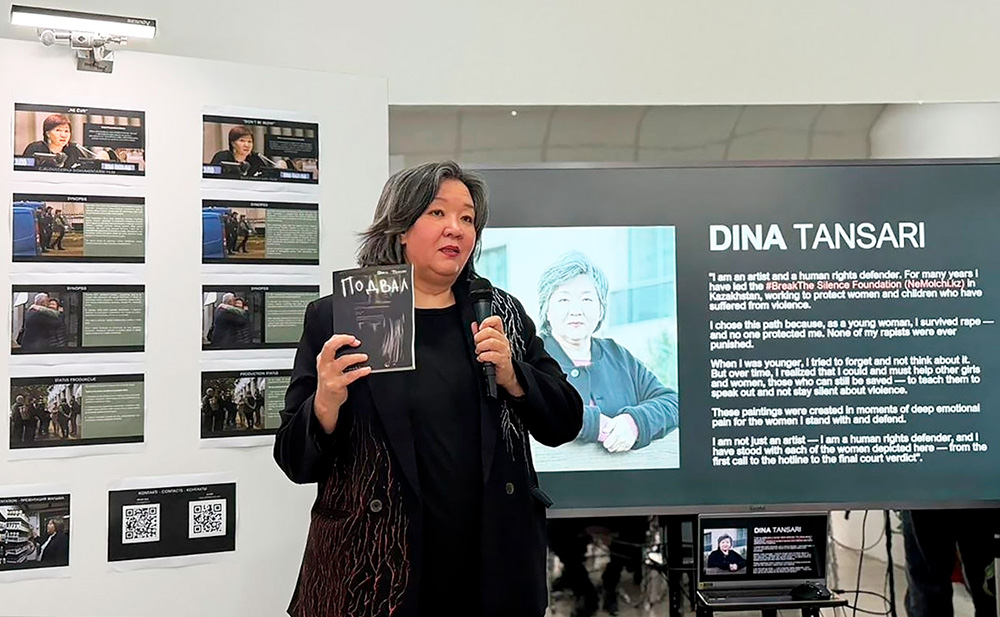 Dina Tansari presents her autobiographical book, The Basement. Photo courtesy of her personal archive
The foundation operates with a seven-person team, five of whom work almost around the clock. Staff members often sleep only four or five hours a night while reviewing evidence of killings, sexual assaults and abuse. Their phones contain graphic images and documents that cannot be deleted because they may be needed for investigations or court proceedings.
Funding has dwindled to the point that the organization struggles to pay team members 200,000 tenge a month, Tansari says. She has continued working through cancer treatment, a heart attack and serious illnesses affecting members of her family.
Art became one way to cope. Her series “The Black Trees of Dina Tansari” is dedicated to survivors and victims whose cases the foundation has handled. Each painting refers to the story of a particular woman, and Tansari hopes to exhibit the collection in Europe.
Society moving faster than the state
Despite the cases arriving at NeMolchi and the pressure on its staff, Tansari sees a significant shift in public attitudes. Ten years ago, she recalls, many people treated violence as shameful private “dirt” that should not be discussed. Survivors now receive broader public support, while journalists, bloggers and psychologists explain how abuse affects women and children.
“Society is changing faster than the police,” she said.
That change, Tansari argues, must now be matched by independent organizations capable of helping survivors without fear of the authorities. State-run hotlines and family support centers can provide services, she says, but quickly become bureaucratic and tend to measure success through budgets and reports rather than the safety of victims.
The new NeMolchi Network is intended to carry the movement’s experience beyond Kazakhstan and strengthen cooperation among activists in several countries. For Tansari, its purpose remains the same as the message that started the campaign in 2016: make violence visible, help survivors defend themselves and refuse to be silent.
-
 30 August30.08The Real Intrigue Comes LaterObservers and experts assess Kazakhstan’s first elections to the new Kurultai parliament
 -
 21 August21.08Elections to a Weakened KurultaiBerit Lindeman, Secretary General of the Norwegian Helsinki Committee, on democracy and the parliamentary campaign in Kazakhstan
 -
 16 April16.04Father Iakov vs. the PatriarchateThe story of the persecution of a Kazakh priest who entered into open conflict with the Russian Orthodox Church
 -
 23 December23.12PhotoTokyo DriveJapan to invest about $20 billion in projects across Central Asia over five years
 -
 17 December17.12Sake for SixCentral Asia’s Rapprochement with Japan Comes with Hidden Pitfalls
 -
 17 September17.09Risky PartnershipWhy Dealing with China Is Harder Than It Seems at First Glance
-

Valeria Ibraeva on the First Contemporary Art Museum in Central Asia, Opened in Almaty
-

How poor planning and a fixation on faulty test results undid months of hard work
-

Kazakhstan becomes the first Central Asian nation to struggle with a second wave of COVID-19
-
How Central Asia fought the coronavirus with quarantines – and appears to be winning